Hello All,
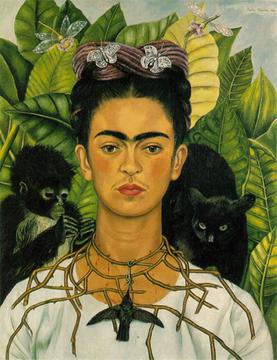
For Monday's post, choose one of these self-portraits to analyze.
What persona is the artist exhibiting? Why do you think he or she chooses to show this mask to the world?
Frida Kahlo's Self-Portait, 1940
Diane Arbus's Self-Portrait with Infant Daughter, 1945.
Ansel Adams's Self-Portrait Monument Valley, Utah, 1958
Helmut Newton's Self-Portrait with Wife June and Models, 1984 (Warning: Nudity)
Friday, January 7, 2011

Wednesday, January 5, 2011
Post for Jan. 7
Hello All,
Pages 3-35 of Stevens's Ariadne's Clue introduce some of the background explanations and contexts for symbols and archetypes. One example he gives of a context in which these symbols and archetypes find expression is in dreams, and he cites a study by psychologists Hall and Nordby in which they classified verious types of dreams that transcend any particular culture or era:
"These typical dreams, as we shall call them, are experienced by virtually every dreamer [...] These typical dreams express the shared concerns, preoccupations and interests of all dreamers. They may be said to constitute the universal constants of the human psyche" (as cited in Stevens, p. 21).
On that same page, Stevens gives a list of these universal dreams.
For your post, describe one dream that you have had that would fall into one of these categories.
For example, Stevens gives the example of "being pursued by hostile strangers"; in one such dream, I was being chased through the woods by a group of villagers with pitchforks and torches. It was night, and I could see the lights from their torches through the trees as I was running. It was almost like I was in a black-and-white monster film from the 1950s and I was the monster. Luckily, I awoke before they could catch me.
First Day of Class
Hello All,
For this trial run, briefly introduce yourself: your name, major, and one surprising detail about yourself.
Then briefly list what you consider to be one of your writing strengths and weaknesses.
For this trial run, briefly introduce yourself: your name, major, and one surprising detail about yourself.
Then briefly list what you consider to be one of your writing strengths and weaknesses.
Wednesday, November 10, 2010
Post for Friday
Hello All,
For this post,
1. name the specific CSUB program, department, activity, or professor you plan on critiquing;
2. describe the form of advertising you plan on critiquing and proposing (webpage, DDH poster, flier, e-mail, television advertisement).
For this post,
1. name the specific CSUB program, department, activity, or professor you plan on critiquing;
2. describe the form of advertising you plan on critiquing and proposing (webpage, DDH poster, flier, e-mail, television advertisement).
Monday, November 8, 2010
Post for November 10


Hello All,
For this post, I just want you to make a descriptive analysis: what archetype does the fruit or cigar label advertisement use?
1. Choose one of the advertisements.
2. Describe one archetype that advertisement uses (each advertisement uses multiple archetypes).
3. Do not repeat a previous entry; make your analysis original and unique.
Friday, October 29, 2010
Post for November 1
Hello All,
This post should be easy (if you were in class on Friday): post your thesis statement for your film analysis.
On Monday, bring your introduction (at a minimum, for you can always write more) to class.
On Wednesday, we'll have a short workshop on transitions, and then we'll spend the rest of the time writing (or revising) your film analyses; the final drafts of those analyses will be due on Friday.
Take care, and have a Happy Halloween !
Wednesday, October 27, 2010
Post for October 29
Hello All,
First of all, I apologize for the game of musical classroom on Wednesday. I thought our DDH classroom would be more comfortable, and who knew there would be a class that starts in there at 8:30 (I should have known, but still!).
Second, as we discussed on Wednesday, come to class on Friday having chosen your film and made a list of the important characters, settings, and plot of that film. This should be in your own words; don't resort to using a Wikipedia summary of the film.
And now, your blog . . .
Choose one of Eliade's concepts from Myth of the Eternal Return, and explain how it fits Sunshine.
The Center
Road to the Center
Abolition of Past/Concrete Time
Restoration of Primordial Chaos (Invasion of the Dead, Abolition of Norms, Sexual Excess, Indeterminate Unity)
Repetition of the Cosmogonic Act (Rekindling of Fire, Ritual Combat, the Erotic Element)
I'll give you an example...
The film uses the Abolition of Past and Concrete Time as one of its starting points; the crew has left Earth and in so doing has lost all traditional ways of measuring time: there are no seasons in space, and there is no night (since they're traveling to the sun, they live a constant day). Furthermore, after Mace and Capa get into their first confrontation and Mace has to get counseling with Dr. Searle, Mace says, "It's the time," to explain one of the causes of his losing control. This is also evident in his persona. Normally, men (especially professionals) shave and keep their appearance clean and neat, but at the beginning of the film, Mace has a scruffy beard and unkempt long hair, implying that he has lost touch with a man's daily rituals; this is another illustration of the idea of being disjointed and out of time.
Subscribe to:
Posts (Atom)